|
|
|
 |
PROBAT has held a global position for decades and the world market leader in the segment of roasting machines and plants for the coffee industry. Today cocoa, malt and nut processing is a further important branch of our company. |
| employees : |
100-499 |
| yearestablished : |
1864 |
biznestype : |
Manufacturer |
Crushing machines
Deshelling machines
Roasting and cooling plants
Cocoa bean crushers
Cocoa cleaning machines
Cocoa mills
Cocoa roasting plants
Cocoa sterilizing plants
Deshelling plants for cocoa beans
Mills
Roasting machines
PROBAT has held a global position for decades and the world market leader in the segment of roasting machines and plants for the coffee industry. Today cocoa, malt and nut processing is a further important branch of our company. Since its establishment in 1868 the development, manufacturing and sale of processing equipment needed to make roasted coffee from green coffee has been a focus of the company. Early on we started applying our knowledge to the roasting of malt, cocoa and nuts, too. Nearly all people who enjoy coffee come into contact with the Probat, as this Emmerich-based company that is rich in tradition enjoys a market share of well over fifty per cent. Put in another way: out of ten cups of coffee drunk worldwide, seven were roasted with equipment made by the PROBAT group. Probat has been operating globally for decades and is a global leader in the market segment of coffee roasting machines, equipment and plants. The product range encompasses everything from shop to king-size roasters and includes whole roasting plants, industrial grinders, electronic control units, computer control units as well as spare parts.
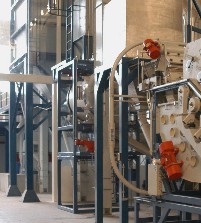
 | Cocoa Processing In co-operation with its subsidiary BAUERMEISTER, PROBAT plans and delivers complete plants for the cocoa industry. We specialise in plants and plant components for the production of cocoa mass, starting from receipt of the cocoa beans through to grinding and blocking-off.
A speciality of PROBAT is the development of plants for so-called nib roasting. We design and manufacture both batch roasters as well as continuous roasting systems. Both can be perfectly configured to produce the required cocoa quality.
A further highlight of our plant technology is the ShellCon FSC pretreatment system. An important advantage: The preparation for separation of shell and nib takes place extremely gently and effectively. In contrast to conventional systems, the cocoa nib is thermally protected due to the special mode of operation with benefits for the environment due to the possibility of heat recovery. This energy saving contributes to reducing operating costs.
Complemented by the range of machines of BAUERMEISTER, we provide complete grinding plants – also turnkey on request – as well as individual machines with an output of 2, 4, 6 and up to 8 t/h.
|  | Exhaust Gas Treatment The increasingly stricter nationally specific environmental protection constraints require not only that chaff and other particles be filtered out, but also the treatment of the exhaust gasses generated during the roasting and grinding process. During roasting, chiefly volatile carbon compounds (Cx), carbon monoxide (CO) and carbon dioxide (CO2) are produced, during grinding carbon dioxide is produced.
The latter can be recycled to a greater part as a protective gas for the conveyor equipment and silos in the ground coffee process. The impurities in roaster exhaust air are usually eliminated through thermal and/or catalytic combustion. Today, catalytic combustion is state-of-the-art; precious metals such as platinum serve as the catalyser. The combustion process takes place at temperatures between 450 and 600°Celcius.
PROFORTE:
The energy required for exhaust air combustion can be distinctly reduced using regenerative thermal oxidation. In this process, the heating energy released during the flameless combustion of the pollutants is stored in a ceramic bed and then most of it released back into the process, which thereby attains a thermal efficiency rate of 95 to 98 percent. Due to the high process temperature of 900 to 1,000°Celcius, the pollutant emissions are far below the prescribed limiting values.
|  | Green Coffee Cleaning Before storage the delivered green coffee is cleaned and weighed. In some plant configurations this takes place in reverse order.
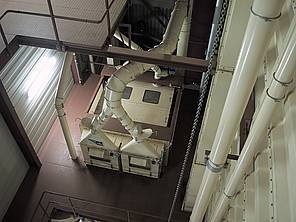
The green coffee received is cleaned of dust and other light particles such as bag fluff and grains of sand while larger foreign particles are sieved out via vibration. Finally, metal parts are removed.
Air cleaner
Circular sieve cleaner
Metal eliminator
Dust extraction units |  | Green Coffee Receipt Green coffee receipt encompasses the process steps of green coffee receipt in a coffee roasting plant to storage in green coffee silos.
Green coffee can be delivered either in single bags, in 60 kg bags stacked on palettes, in larger container bags (big bags) or even as a bulk commodity in containers or on trucks. Depending on the packaging at receipt, various auxiliary equipment can be used to depalletise, decollate and transport it into the coffee refinement plant.
When emptying the delivered bags the green coffee is quality checked. This is done either manually or automatically using a green coffee sampler. At the same time, green coffee moisture can be measured.
Green coffee dumping station
Belt conveyor |  | Green Coffee Transport Depending on the application area the requirements for a conveying system can differ considerably. PROBAT thus offers various conveyor systems tailored to respective needs. A rough differentiation can be made between mechanical and pneumatic conveyor systems.
PROBAT’s mechanical conveyor systems are usually constructed in a more simple way and thus less flexible. However, because of their modular construction, local conditions can be considered without cost-intensive adaptations. In comparison to pneumatic systems, investment costs are significantly lower, especially in cases of short and straight conveying paths.
Pneumatic conveying systems transport the product via high pressure or low pressure. In principle, conveying always takes place in closed pipe or tube systems. Pneumatic conveyor systems are characterised particularly by conveyor lines that can be flexibly laid out and by the largely arbitrary number of pick-up and dumping stations that can be selected.
Mechanically
Drag-chain conveyor
Vertical bucket elevator
Tubular-rope conveyor
Round-chain conveyor
Pneumatically
High-suction conveyor plant
High-suction conveyor (NEPTUNE 200)
High-pressure conveying unit |  | Installed Plants On the following pages we will give you impressions of plants – S to XXL – that have already been installed.
| |
|
|
<