|
|
 |
PRIMA INDUSTRIE’s systems are installed all over the world for the cutting • welding and drilling of bi-dimensional (2D) • three-dimensional (3D) components for the most diverse applications |
| Year established : |
1977 |
Business : |
Manufacturer |
Air treatment/ smoke and dust filters •
Blanks (incl. laser, plasma, waterjet cut parts etc.) •
Combined laser cutting/ forming machines •
Cutting centres •
Cutting to length/ trimming; general •
Extraction/ filter devices/ booths •
Integrated design solutions (2D/3D) •
Laser cutting machines •
Plasma and laser beam welding and cutting equipment •
Robots for sheet metal working/ handling •
Sheet metal working centres •
Welding robots •
PRIMA INDUSTRIE S.p.A. is worldwide leader in the field of high power laser machines for industrial applications. Thousands of PRIMA INDUSTRIE’s systems are installed all over the world for the cutting, welding and drilling of bi-dimensional (2D) and three-dimensional (3D) components for the most diverse applications. After 30 years from its incorporation, PRIMA INDUSTRIE’s mission is still the same of its origin: innovation, excellence, growth.Competence and experience in the laser machines sector, passion and dedication, strong investments in Research and Development, have allowed a continuous evolution of the Company, its products and its services. Today PRIMA INDUSTRIE has about 600 employees and its headquarters are in Turin. The manufacturing facilities are in Italy (PRIMA INDUSTRIE and PRIMA ELECTRONICS), United States (PRIMA North America) and China (SHANGHAI UNITY PRIMA and SHENYANG PRIMA). A diffused distribution system is active in more than 40 countries. PRIMA INDUSTRIE’s consolidated turnover in 2006 was euro 148 million (+ 33% with respect to the previous year), achieved for over 75% from exports in the five continents. The high rates of Customers’ loyalty, the achievement of the ISO 9001:2000 certification, the successful company listing on Nuovo Mercato in 1999 (presently STAR segment) and the various international awards received, testify PRIMA INDUSTRIE’s professionalism and dedication to quality in every aspects of its activities.
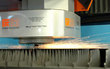
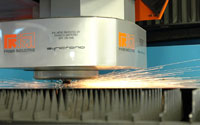
 | 2D LASER CUTTING Today laser cutting is one of the most widespread material processing techniques, particularly for flat (2D) or bended and formed (3D) sheet metal.
Compared to mechanical tools (shearing, punching, milling, etc.), the laser has many benefits:
maximum application flexibility: any material can be virtually processed (all kinds of steel, aluminium and its alloys, titanium and many other metallic materials, but also the greatest part of plastic materials).
no limit to the shapes which can be obtained: any path, also the most complex one and the most sharp corners, can be cut, since the laser tool is punctiform.
superior accuracy and no part distorsion caused by heat and mechanical stress of the tool;
no tool wear.
Many thousands of 2D laser systems are at work all over the world. Higher production rhythms - and therefore higher cutting speed on all materials - and more and more efficient systems for loading/unloading/storing of raw and finished sheets are increasing requirements in this sector. These are associated to the problems of the collection and treatment of the fumes and dust produced during the process, and of the protection of the operator and the environment.
In order to grant the widest application flexibility, the highest performances and safety standards, PRIMA INDUSTRIE 2D machines use CO2 lasers, mostly manufactured within the Group, and PRIMA ELECTRONICS numerical controls. Unique responsibility and total control of the technology are thus granted.
Many machines are dedicated to intensive production within a totally automated industrial process, but the most typical user is the high quality job-shop, exploiting the performances and the flexibility of the laser tool for his daily achievement on the market. |  | 3D LASER WELDING Laser welding exploits the capability to concentrate high energy in a punctiform and very small spot, melting the material of the parts and creating a highly stable and resistant joint between them. The energy brought to the part is focused on the joint and therefore the heat affected zone and the part distorsion are minimal.
The are two kinds of welded joints: lap joints or butt joints. In any case, and in particular for butt joints, the quality and the presentation of the edges to be welded is of the greatest importance: they must be accurately prepared, referred, joint and clamped during the process.
Often it is better to make some tack-welds to be sure that the edges are kept joint during the process. This means that reference and clamping devices play a leading role in the welding process, much more than in the cutting one.
Generally, laser welding is autogenouos. Sometimes, for metallurgical reasons (e.g. for some kinds of aluminium) or when the joining is not perfect and needs to be filled, filler material can be used. The laser welded joints are generally thin and can be cleaned and/or smoothed more easily than the joints obtained with other welding techniques. Consequently, laser welding is particularly suitable when the appearance of the articles is essential (e.g. tableware, kitchenware, furnishing) or for hygenic reasons (e.g. gaps or extra material which can become "biological traps" in the food or medical industry).
It has already been mentioned the importance of referencing and clamping systems: with conventional tools the fixtures complexity and costs can be very high. With a laser system, on the contrary, it is often possible to precess the workpiece in a single phase. In fact, since the laser head can move around the part in any of its sides, there’s no need to reposition the piece. This drastically reduces the number and the complexity of the fixtures needed.
In 3D applications lap welding is almost always used. The parts are often formed and, therefore, the fixture must force the parts in their nominal position, overcoming spring-backs. The fixture must refer, force and keep the parts joint during the process, while the laser head moves along the path to be cut.
On the weld stitch it is usually brought an inert gas (usually Nitrogen or Helium or Argon) in order to avoid the welded joint oxidation. Usually, this gas is brought through a nozzle, coaxial to the focused laser beam. When the gas is not required or it can be brought through the fixture, the nozzle is not necessary. This technique is called HOW (“Hands Off Welding”) and it is available on PRIMA INDUSTRIE 3D laser machines. It consists in the "remote" welding (at a distance of 150÷200 mm): no need to bring the laser head near to the part to be processed. The fixtures become simpler and the cycle times are sensibly reduced.
In the automotive sector for car body parts it is used the stitch welding (more or less similar to classic spot welds): with any technology most time is spent to move the machine (or the robot) from one stitch (or spot) to the next one. With the laser the so called "remote welding" is possible, keeping the machine head far away from the part (till one meter or more) and guiding the focused laser beam with oscillating mirrors. The repositioning time from one stitch to the next one is virtually eliminated (less than 0.1 socond on average), allowing very short cycle times. The AGILASER by PRIMA INDUSTRIE is today the largest and fastest remote welding system available on the market.
It is worth mentioning that all PRIMA INDUSTRIE welding machines can be turned into cutting machines, replacing in few seconds one part of the focusing head.
For 3D welding PRIMA INDUSTRIE offers:
RAPIDO
OPTIMO
AGILASER
|  | LASER DRILLING Laser drilling makes it possible to machine both very small and precise holes in a variety of shapes and orientations, in a wide variety of materials, including difficult-to-machine aerospace alloys. These holes can be tapered or shaped to enhance the amount and direction of air or liquid flowing through them.
The drilling of holes in aerospace/turbine engine parts generally serves to enhance the cooling characteristics of the part. These holes can be drilled at extreme angles to the surface. Hundreds or thousands of cooling holes can be drilled in one part with a single set-up in cylindrical or unusually shaped parts.
A high power pulsed Nd:YAG laser is normally used although a CO2 laser can be used with non-metallic parts. Processing is accomplished through either percussion drilling or trepanning. In the laser drilling process, high power density is accomplished by using a high power laser and a focused spot size of 0.05 mm to 0.75 mm.
Percussion drilling can be described as delivering one or more pulses from the laser to a part while the laser beam and part are stationary. More than one pulse may be required depending on the material thickness. A variation of percussion drilling is "drill-on-the-fly" where pulses are delivered to the part by a stationary laser while the part is rotated. Hole placement is a function of rotational speed and laser pulse frequency. If multiple pulses are required, "Fire-On-The Fly", a software package developed by Laserdyne engineers, is utilized to synchronize the movement of the part to the laser pulses, ensuring that multiple pulses are delivered to the exact location required. By changing the laser pulse energy, pulse count or lens focal length, the characteristics of the drilled hole size and taper can be controlled to meet the design requirements of the part. Fire-On-The-Fly software can also change the pulse shape during the process to improve hole geometry.
Trepanning is another process for drilling holes. The part is held stationary and the laser beam is moved to create a hole or feature by cutting the shape. The term "drilling" is generally used until the diameter of the hole or feature exceeds the material thickness. The advent of extremely accurate and repeatable laser positioning systems allows for very unique and tight tolerance trepanned features. Shaped hole drilling is an emerging variation of trepanning where designers of aerospace and land based turbine components now have increased flexibility to create new designs and cooling concepts.
Laser hole drilling technology is employed on every turbine engine used in aircraft and/or land (power generation) applications. Automotive engineers, filtration designers and medical manufacturers are a few of the other users of laser technology that would not be able to manufacture their parts without the laser drilling process.
For laser drilling PRIMA INDUSTRIE offers its:
LASERDYNE systems
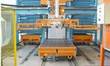
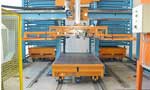
|  | Material Handeling Thanks to their increasing performances and reliability, today laser machines are widely used also for intensive production. Efficient systems for the raw and finished parts handling are therefore becoming more and more important.
For 2D applications PRIMA INDUSTRIE offers its complete line of automatic sheet metal handling systems:
PrimaServer
For 3D applications PRIMA INDUSTRIE offers some standard solutions:
Turntables
"Monofrontale" loading/unloading systems
Whatever your needs, PRIMA INDUSTRIE can develop the most proper solution thanks to its wide and qualified experience in this sector. | |
|
|